Research & Career Development
Growing curiosity and opportunities

Students in HEP are opening their minds and stories to new experiences. This is a time when they also tend to be eager and excited to continue their education and/or apply it in writing and publishing, mentoring others, applying to graduate school, or career opportunities. Many HEP programs provide opportunities for students to support others, formally as Teaching Assistants or informally as mentors. The National Alliance for Higher Education in Prisons has developed a growing practice and advocacy around work-based learning and paid job opportunities for people who are incarcerated.
Career planning

HEP recognizes the need for career planning and support for its students in consideration of the unique context of being incarcerated and having a criminal record. Leveraging resources from SDSU Career Services, Project Rebound, and local and national sources, the VISTA team routinely provides workshops at Student Services sessions and embeds career development in courses to provide students with this support. For example, dedicated student support services workshops are held on applying to graduate school, careers in journalism, navigating the job market with a criminal record, and resume and CV building, supplying students with information and support for planning their career paths.
CV and resume building
Specific support is provided to VISTA students in terms of CV and resume writing. Whether students plan to further their education or enter the workforce (or both), team members offer Student Services workshops on building resumes and CVs as well as integrate these activities into the classroom. For instance, in the Capstone course, students engage in professional development through submitting assignments with their resumes or CVs for feedback. Through multiple revisions, students leave the course with a complete resume or CV for their use and continued development.
Support for TAs, peer educators

There is a growing national interest in work-based learning, as seen by the National Alliance for Higher Education in Prison's 2025-26 focused cohort with this intention. SDSU was selected to participate in this national cohort, with Professor Annie Buckley and Dr. Tereza Trejbalova participating in the project. Led by Director of AHEP, Ved Price, the cohort aims to advocate for and create opportunities for work-based learning and employment for those who are incarcerated by outside organizations.
Some earlier options, ahead of a prison agreeing to active employment by an outside organization, include HEP students serving as teaching assistantships, or working in paid internships. Within VISTA, the team is actively working to push for paid TAs but has already started a pilot program in which an alumni of the program operates as TA to give back.
National Alliance for Higher Education in Prison
Coordinating events with main campus and prison campus
Coordination of main campus and prison campus events requires open communication with prison staff, advanced planning, and knowledge of the policies and procedures for achieving approval for a variety of activities.
Cohort model, peer and alumni support
The VISTA program is built around a cohort model in which students progress together, fostering collaboration, shared learning, and a strong sense of community inside the prison classroom. This structure encourages peer support, as participants engage in rigorous coursework, mentorship, and collective intellectual growth that helps them overcome barriers and stay motivated. As graduates transition into alumni, they become part of an ongoing support network, extending the program's impact beyond graduation through continued connection, inspiration, and opportunities for future cohorts.
Expanded Campus and Research and Career Development
Student Publications
VISTA journalism students have the opportunity to publish their work in the Daily Aztec, San Diego State University's main campus newspaper. Staff members from the paper visit the program to explain the submission process and highlight opportunities for incarcerated students to contribute their voices. Submissions are accepted twice each academic year (during the fall and spring semesters) and include written articles, artwork, or cartoons focused on themes such as art and rehabilitation, education in prisons, and student research projects.
Research Fair

Providing meaningful opportunities for VISTA students to engage in research is core to HEP goals and integrating VISTA into the broader SDSU community. A core research related event is participation in the main campus research symposium, S3. This event is a campus-wide research conference with posters and oral presentations that are judged by faculty. Working closely with the Division of Research and Innovation staff, team members developed a strategy for VISTA students to showcase their research at the symposium. Team members and faculty mentor students in preparing research topics and developing abstracts for submission. Once accepted, students create a poster presentation on their research to be shown during an interval at the event.

Symposium staff dedicate a section of the poster session space in Montezuma Hall for the VISTA student posters. Team members are available to answer questions and discuss with visitors the students' research. Signs describing the VISTA program are also placed at the entry of the poster exhibit to provide information to visitors. Student posters include a QR code that takes listeners to a recorded presentation of the research project in the student's own voice. This feature expands the reach of incarcerated students to the main campus community and allows visitors viewing their research to connect with the author.

The traditional judging format is adapted for VISTA students since they are not physically present to answer questions or dialogue about the research. Instead team members rely on current students to provide feedback and ratings via online feedback forms that they can complete while observing the posters. This feedback is compiled and provided back to the students. Ratings are analyzed and students with the highest scores are selected as symposium winners. These winners are announced at the symposium awards ceremony.
Student Projects
Post-Incarceration Reentry Shock (Joel A.)
Read transcript: Post-Incarceration Reentry Shock (Joel A.)
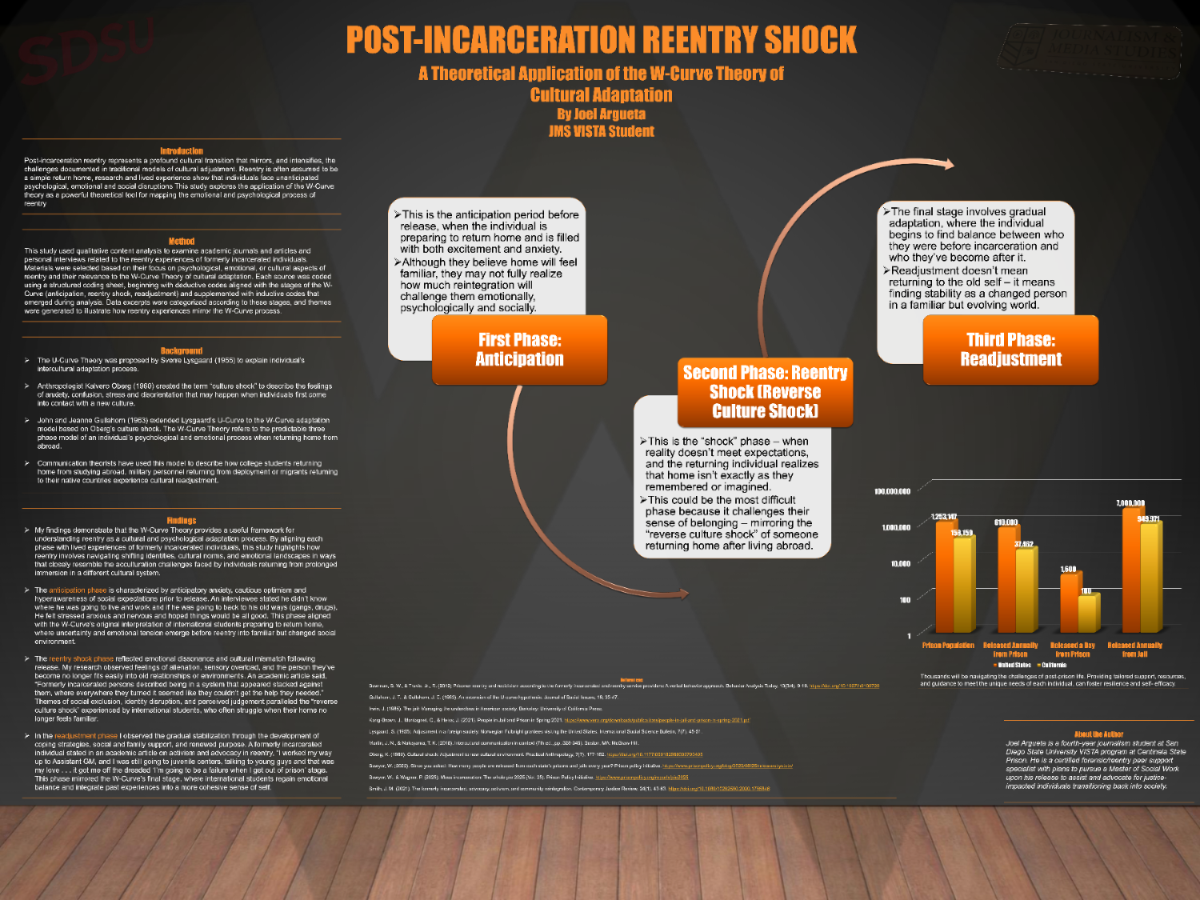
Have you ever returned somewhere familiar and it suddenly didn't feel like home anymore? For many people coming home from incarceration, that's exactly what reentry feels like, and the W-Curve Theory helps explain why.
Hello and welcome. My name is Joel A., and I'm a fourth-year journalism student. In my research, I incorporate the W-Curve Theory of Cultural Adaptation as a framework to understand the emotional and psychological adjustment formerly incarcerated individuals experience when returning home. This theory is traditionally used to describe international students adjusting to a new culture and then readapting when returning home. I apply the theory to post-incarceration reentry to explain how deep personal transformations during incarceration change social environment and community expectations, resulting in us not returning to the same world we left. Using this theory helps highlight why reentry is not a simple transition, but instead a complex psychological process with predictable stages.
The W-Curve offers three phases, apprehension, reentry shock, and readaptation, that closely mirror our reentry journey. During apprehension, an individual is excited yet anxious to be released, as independence and a changing environment bring positive feelings but also uncertainties. As an individual moves into reentry shock, they may feel disoriented by rapid changes in society, stigma and alienation, and an overwhelming number of choices. When readaptation occurs with time and support, they rebuild trust, redefine relationships, and regain confidence. Rather than trying to fit back in, they learn to integrate the lessons and resilience they developed while incarcerated into a new identity.
This study used qualitative content analysis to examine academic journals and articles and personal interviews related to the reentry experiences of formerly incarcerated individuals. Each source was coded using a structured coding sheet, beginning with deductive codes aligned with the stages of the W-Curve, apprehension, reentry shock, readjustment, and supplemented with inductive codes that emerged during analysis. Data excerpts were categorized according to the stages, and themes were generated to illustrate how reentry experiences mirror the W-Curve process.
This framework is important for future research because it offers a structured method to study the emotional and cultural challenges we face as returning citizens beyond just housing, employment, or rural conditions. By exploring this phenomenon further, professionals can design better reentry programs, mental health interventions, and peer support systems that recognize the need for gradual readjustment rather than immediate reintegration. Understanding the W-Curve and reentry can eventually lead to more humane policies and stronger support networks that will reduce recidivism and promote our long-term success.
I chose this topic because the W-Curve theory reflects what many of us experience when we are released. As a currently incarcerated person, I relate deeply to the emotional ups and downs that come with the major transition. I'm preparing to go home next year, and understanding these phases isn't just academic for me, it's personal. I want to pursue a master's of social work and eventually work directly with formerly incarcerated individuals. This theory gives language to something our community feels but rarely has a chance to name. By studying it, I hope to contribute to more informed, empathetic, and effective reentry practices in the future.
Thank you.
The Benefits of Arts in Prisons (Roberto M.)
Read transcript: The Benefits of Arts in Prisons (Roberto M.)
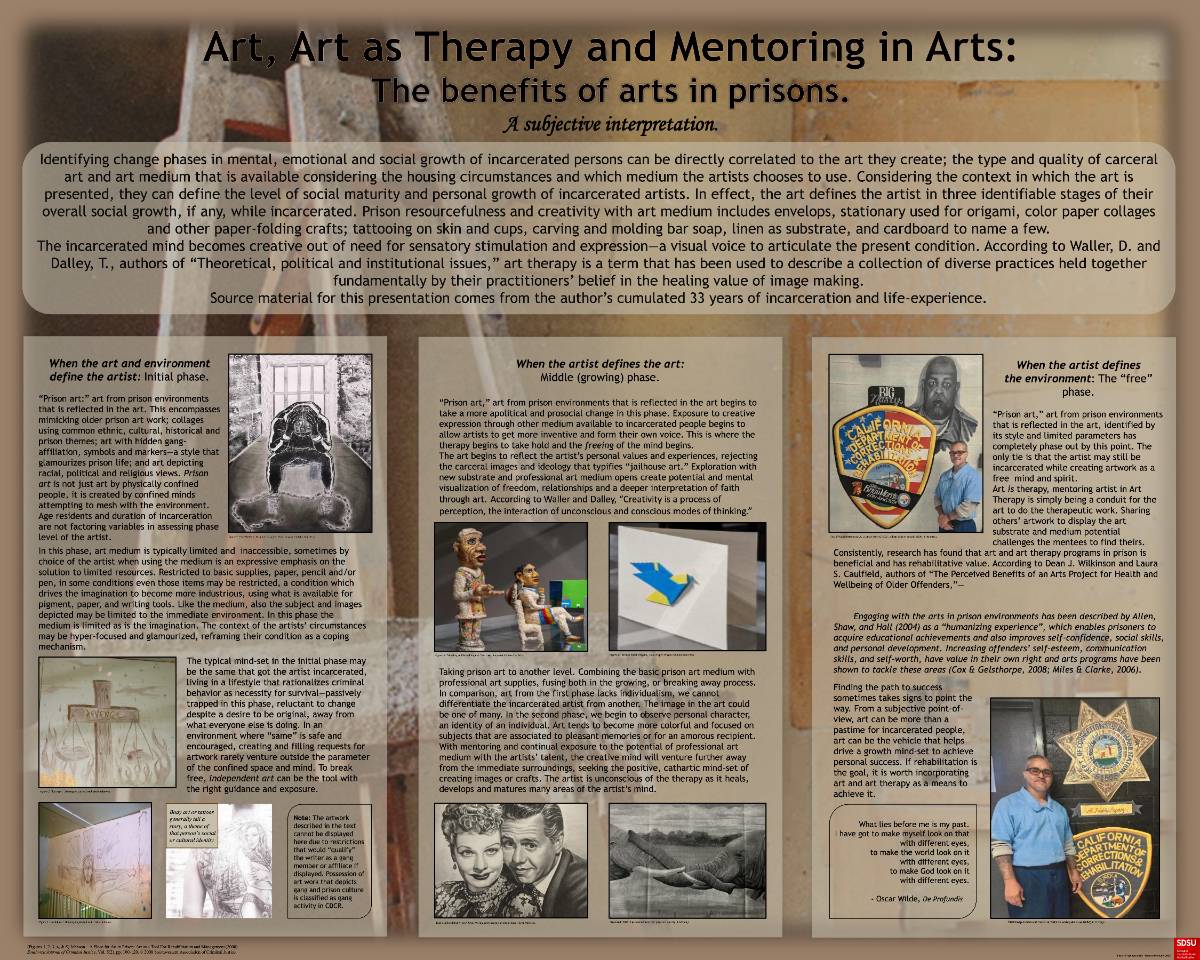
Art as Art Therapy and Mentoring in Art is the title of my poster presentation. This project is a subjective interpretation of what I have come to understand regarding art in prison and how incarcerated artists not only define art, but how art defines the incarcerated artist. This presentation is sourced from years of observation of my life experience and from my own identification as a confined artist, incarcerated and mature in ways that can reflect in my art. I am an artist in prison. I do not create prison art simply because I am in prison.
My name is Roberto M., and I am an SDSU JMS student. My life experience of years of observation of carceral art in the state institutions totals 33 years, 8 years as a ward in the California Youth Authority and 25 years as a resident in the Department of Corrections and Rehabilitation.
My observations have motivated me to create this poster presentation and outline three phases, or groups, of informal assessments of incarcerated artists' social condition from the date their art was created.
I observed the same images reproduced time and time again. The same morphed images of prison watchtowers, and images of women with their hair connected to other objects, in collage prison art, since my time in juvenile institutions to all the prisons. The changes or additions to this jailhouse art are images that reflect, at times, adding modern technologies and luxury automobiles in place of the classic lowrider and background scenes, as newer versions of the same art.
By getting to know the artists that created this type and other prison arts and crafts of the same style or genre, I noted a consistent correlation. In my opinion, the art or craft told a lot about the artist that created it. This correlation became so common, I naturally attributed criminal mindset to the type of art as a measuring gauge to determine my association with those incarcerated artists. My willingness to teach and share my art with other incarcerated artists was based on the student artists' will to be taught. I found that the demeanor of artists who drew jailhouse art were stunted artistically, socially, and mentally, influenced by others, hyper-focused on the external factors of their conditions, and resistant to change. Some aggressively defended their techniques.
Carceral art, and what I can suggest about the artists in regards to the resident's social and personal development while incarcerated, can be assessed and categorized by phases or maturation groups that reflect social, personal perspectives of those resident artists. These range from phase one, two, and three.
Phase one consists of images depicting gang culture, prison scenes, violence, drug use. Images that glamorize life in prison, using limited medium, usually pen and paper, in a typical style called jailhouse.
Phase two is a transition, or growth phase, in which the artist matures. The growth can be seen in the development of art style and use of professional art medium. During this period, the art may teeter between art styles, mixing jailhouse style with pro-social images.
Phase three, art reflects a free, pro-social mentality, or simply art. This entails free, expressive art styles, more diverse mediums, and subject images that reflect beyond the confines of the prison parameter. Usually images that express fond memories of family members and spouse photographs.
Social and personal growth is defined as a maturing and development of pro-social views and correlating behavior away from criminal ideologies of incarceration, growth away from the artist's criminal social groups and their negative perspective on society, which includes continued criminal behavior and drug use. In identifying three categories or groups that can be classified by the style, type, medium, and subject the artists use.
Excuse me. In so much as considering the place of confinement, i.e. temporary detention housing and security housing units, that impose restrictions to access to materials that can be used for mediums. This fosters thinking outside the box, literally, to be creative.
Today, I understand, with mentoring and exposure to the vast range of art mediums, all artists can develop new, original styles and express their own thoughts, opinions, beliefs, and desires, instead of perpetuating an artistic stereotype or plagiarizing someone else's art, regardless of the artist's circumstance. In this process, artists mature and grow socially and mentally. This understanding helped me to gain patience with tutoring and mentoring residents, persuading me to promote art as therapy to anyone who is interested in learning a professional art medium or style of art that I can obtain, learn, and share.
I believe through art, the mind and spirit can be freed even while the body remains confined.